Since 1980, the year Ronald Reagan was elected, there have been eleven presidential elections. According to exit poll data in each of those elections, the plurality or majority of secular voters have supported the Democratic Party candidate. This preference has increased substantially in recent years; the 1980, 1984, and 1988 elections are the most “competitive” in terms of the margin of victory the Democratic candidates achieved among the secular. Elections in the 1990s (’92, ’96, and 2000) saw support for Republicans hit its lowest points, with nonreligious voters abandoning GOP candidates in large numbers. In the current century (since 2004), Democrats have reached their highest levels of support from secular voters so far.
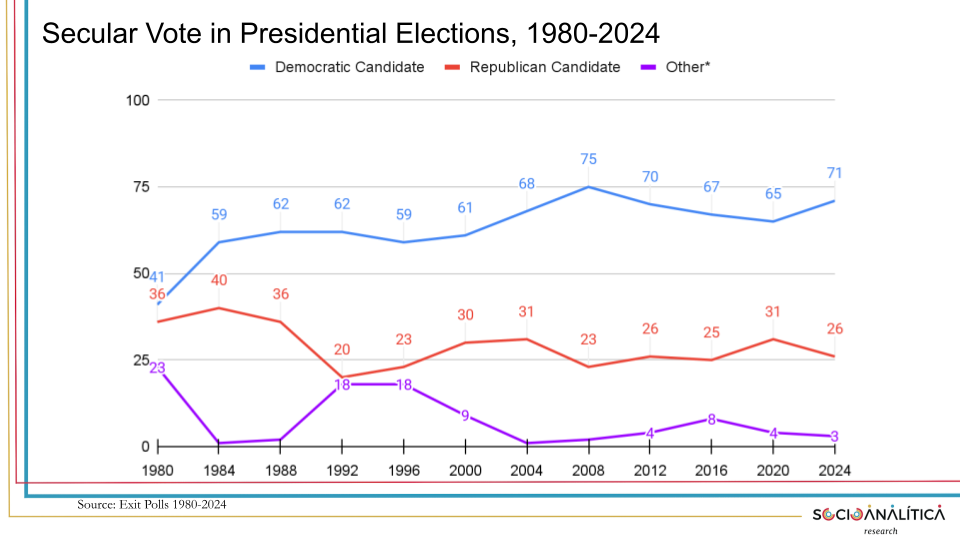
In 1980, the incumbent Jimmy Carter, a Democrat running for reelection, received 41 percent of the secular vote. His opponent and the winner of that election, former California governor Ronald Reagan, received 36 percent of the secular vote. That five-percentage-point margin would be the closest a Republican presidential candidate would ever get to a Democrat among the secular. By 1984, the Republican share (for Ronald Reagan) had increased to 40 percent, while the Democratic share (for former Vice President Walter Mondale) was 59 percent in a year that Reagan won in a landslide. In 198,8 the Democratic candidate, Massachusetts governor Michael Dukakis, won a majority of the secular vote (62 percent) while the winner, Vice President George H.W. Bush, received 36 percent of the secular vote as the Republican candidate. This was the last time a Republican received at least one-third of the secular vote.
The 1980 election is also a major example of another characteristic of the secular vote, the high level of support for third-party and independent candidates. That year, John B. Anderson, a Republican congressman from Illinois, ran as an independent and received nearly 7 percent of the popular vote and 12 percent of the independent vote. In 1980, roughly one-quarter of secular people (23 percent) voted for third-party or independent candidates, including 16 percent who voted for Anderson.
The 1990s were stable for Democratic candidates, but can be considered the lowest point for Republican candidates in terms of support from the secular. The Democratic candidate in 1992, Arkansas Governor Bill Clinton, matched Dukakis’s performance four years earlier (62 percent). Four years later, 59 percent of secular voters voted for his reelection. On the Republican side, President George H.W. Bush received just 20 percent of the secular vote in his 1992 reelection bid, while former Kansas senator Bob Dole, the 1996 Republican candidate, fared slightly better with 23 percent. The decade closed with Vice President Al Gore earning 61 percent of the secular vote as the 2000 Democratic candidate, matching the performance of his predecessor. The 2000 Republican candidate, Texas Governor George W. Bush, improved on his father’s 1988 performance and received 30 percent of the secular vote in winning the presidency.
Once again, secular supporters backed independent bids in large numbers in the 1990s. In 1992, businessman H. Ross Perot shocked the political world when he received 19 percent of the popular vote. The secular were part of that overall trend, with 18 percent voting for him. In 1996, when Perot ran again and received 8 percent of the vote, 13 percent of secular voters cast their ballots for him. Overall, 18 percent of secular voters supported third-party and independent candidates in 1996. In 2000, 7 percent of secular voters supported Green Party candidate Ralph Nader, who received 3 percent of the popular vote. Nine percent of secular people voted for candidates outside of the two major parties.
In the six elections in this century, all the Democratic candidates have received at least 65% of the secular vote. Massachusetts Senator John Kerry received 68 percent of the secular vote in 2004. Three-quarters (75 percent) of secular people supported Illinois Senator Barack Obama in his 2008 presidential bid. Support from secular voters declined slightly but consistently over the subsequent three cycles, with 70 percent supporting Obama in 2012, two-thirds (67 percent) supporting former Secretary of State Hillary Clinton in 2016, and 65% favoring former Vice President Joe Biden in 2020. Biden’s total was the lowest in the century and the lowest since Al Gore’s 61% in the 2000 election, which included high support for Ralph Nader among secular voters.
For Republicans, 2004 was a high mark; 31 percent of secular voters supported President George W. Bush for reelection, the highest since Reagan received 40 percent twenty years earlier, a figure only matched by Donald Trump’s 31 percent in his first reelection bid in 2020. Between 2004 and 2020, Republican candidates have struggled to get 30 percent of the secular vote. Arizona senator John McCain received 23 percent in 2008, former Massachusetts governor Mitt Romney received 26 percent, while Donald Trump received one-quarter of the secular vote in 2016. In 2024, Trump received 26%, in line with the secular GOP vote this century.
Except in 2016, twenty-first-century elections have lacked the high-profile third-party and independent candidate bids of the 1990s, and most secular voters have voted for candidates from the two major parties. In 2016, 6 percent of Americans voted for an array of third-party and independent candidates, including former New Mexico Governor Gary Johnson of the Libertarian Party, physician Jill Stein of the Green Party, and former intelligence officer Evan McMullin. Eight percent of secular voters voted for these and other candidates, the highest level of support for third-party candidates since 2000. Without high-profile non-major party candidates, few secular voters cast their vote for other candidates in 2020 and 2024.