Published in Secular Politics on 10/23/2025
Earlier this week, PRRI released the latest American Values Survey. While the survey contains a lot of information, I want to focus on five specific items that demonstrate how the secular population in the United States is essentially the heart of the resistance against Donald Trump.
Disapproval of Trump
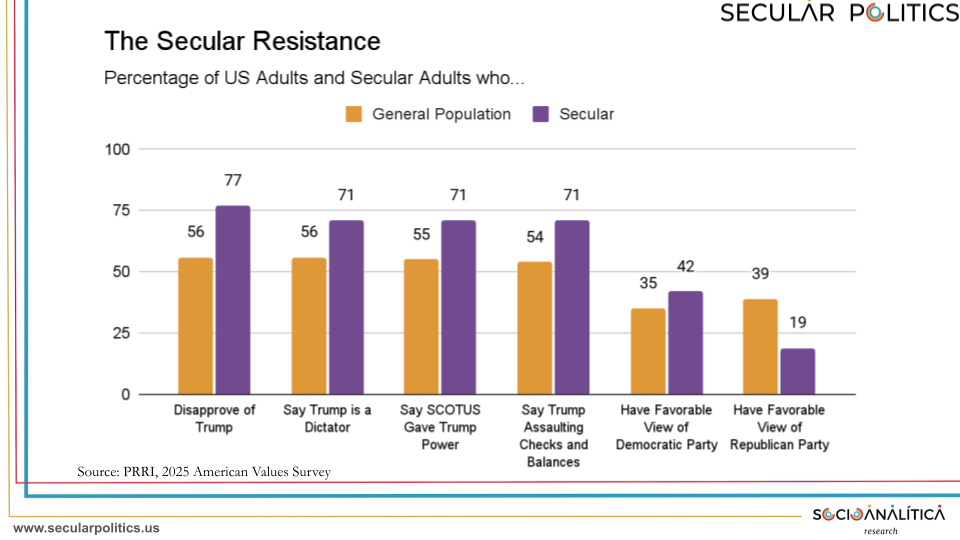
Secular adults are the most likely to disapprove of Trump. While a majority of adults in the United States disapprove of Trump (56%), no group disapproves of him as strongly as the secular cohort. More than three-quarters of secular adults (77%) disapprove of the job that Donald Trump is doing, while only about 22% approve of his presidency. Additionally, although only 35% of US adults have a favorable opinion of Vice President JD Vance, even fewer (17%) secular adults do.
Perception of Trump as a Dictator
A majority of US adults (56%) agree that Trump “is a dangerous dictator whose power
should be limited before he destroys American democracy.” However, among the secular population, three-quarters (75%) agree, including 62% who strongly agree with the statement.
Assault on Checks and Balances
Among US adults, a majority (54%) believe that the Trump administration’s “changes to the federal government represent an ‘assault’ on constitutional checks and balances.” For secular adults, this figure rises to 71%. Just over one-quarter (27%) of secular adults say that Trump’s dismantling of the federal government “is a long-overdue correction of disastrous policies pushed by elites at the expense of ordinary Americans.”
Supreme Court’s Abdication
A majority of adults (55%) consider that the Supreme Court “has been too willing to let President
Trump expand his power.” Among secular adults, this concern is even greater, with 71% agreeing that the Supreme Court has granted Trump excessive power.
Opinions of Political Parties
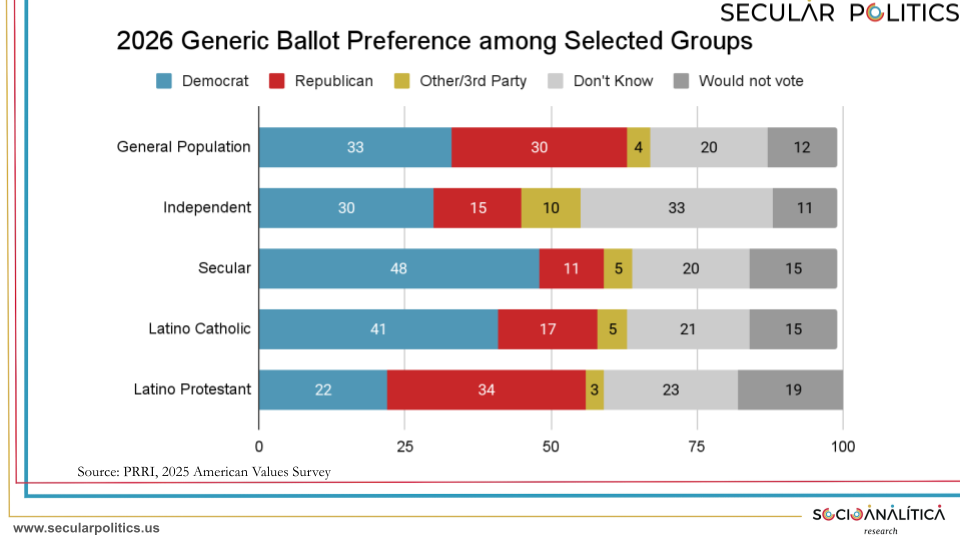
Overall, the Republican Party has a slight advantage over the Democratic Party in favorability among adults, with about 39% having a favorable opinion of the Republican Party, compared to just over one-third (35%) for the Democratic Party. Not surprisingly, among secular adults, fewer than one in five (19%) have a favorable opinion of the Republican Party. However, even though secular adults express the most disapproval with Trump and his administration, only 42% have a favorable view of the Democratic Party, just slightly higher than the general population.
Final Thoughts
It is clear that secular people in the United States are unhappy with the state of the country and the direction the Trump regime has taken since January. They do not like Trump personally, do not like what he is doing, and do not like his enablers. Yet, while their opinion of the Democratic Party is higher than most US adults, it is not as high compared to how much lower secular people’s opinion of Trump and the GOP is.
PRRI does not break down the reasons people give for having unfavorable views of the party by religious affiliation. However, knowing what we know about secular people from this survey (they do not like Trump and his actions) and their overall politics (very progressive), I would not be surprised that they heavily lean toward “is not progressive enough,” “does not represent the interests and values of people like me,” and “is not fighting hard enough against President Trump.” These were the most common responses given by Democrats who have an unfavorable opinion of the Democratic Party.