Published on 7/2/2025 in Secular Politics.
The Tyranny of the Majority
The Pew Research Center recently released a new analysis of its religious landscape survey, which includes questions about public support for teacher-led prayer in public schools. Their study highlights public sentiment regarding the separation of religion and government, demonstrating how surveys on these issues may not fully capture the complexity of the problem in contemporary American politics.
The report indicates that a majority of Americans favor both generic (57%) and explicitly Christian (52%) teacher-led prayer in schools. An examination of different states reveals that areas with large numbers of conservative Christians are most likely to support school prayer, particularly Christian prayer. Conversely, states with significant numbers of secular (religiously unaffiliated) people, such as Oregon, New Hampshire, and Vermont, are among the most likely to oppose teacher-led prayer of any type in public schools.
Fortunately, the Pew Research Center released a limited dataset that includes these questions, providing insights into differences based on religion. Unsurprisingly, Christians, particularly Protestants and Catholics, show strong support for both generic and Christian prayer in schools. In contrast, large majorities of religious minorities (non-Christians) and non-religious individuals oppose teacher-led prayer, especially Christian-led prayer.
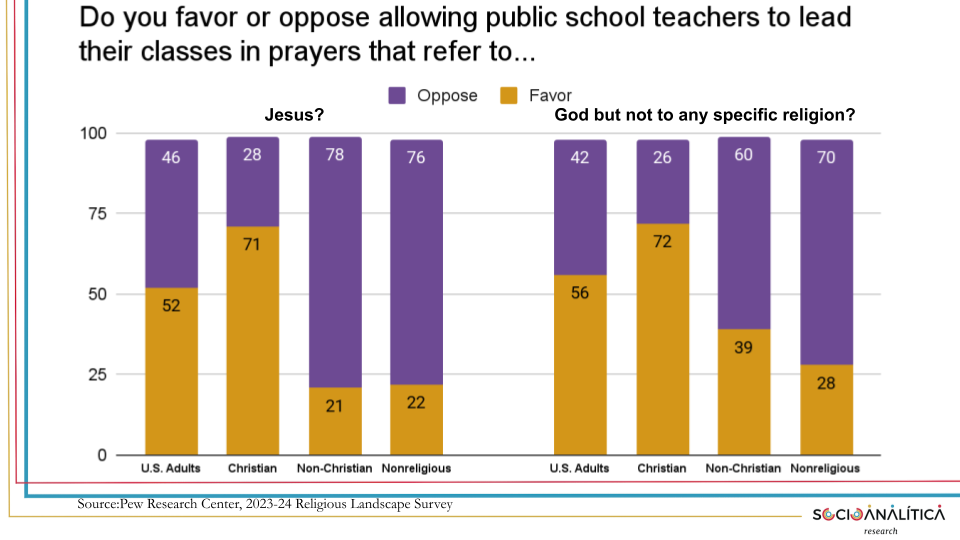
People who are religious but not Christian oppose teacher-led prayer in schools by 21 percentage points (60% opposed, 39% in favor). Their opposition to Jesus-specific prayer is even more vigorous: 78% oppose and just 21% favor, a 57-point difference. Among the nonreligious, opposition to teacher-led prayer is even more robust. Seven in ten (70%) oppose a generic God teacher-led prayer, and just 28% are in favor. When the prayer invokes Jesus by name, opposition increases to 76% and just 22% are in favor.
Compare these numbers with how Christians perceive the issue. People who identify as Christian, whether Protestant, Catholic, Mormon, or any other type, overwhelmingly favor prayer in schools. More than seven in ten Christians are in favor of both Jesus-specific (71%) and God-generic (72%) prayer. So, while the Pew report is correct that a slight majority of people are in favor of teacher-led prayer in schools, this is an artifact of the tyranny of the majority in a country that is 62% Christian, 29% secular, and 7% non-Christian religious.
What’s in a Question?
While the Pew Research Center deserves commendation for addressing this crucial issue, central to the U.S. Constitution, the survey’s question was flawed. This issue is not unique to this survey but reflects a broader problem in how the separation of religion and government issues are approached in polls. The survey lacks context regarding what “teacher-led prayer” truly signifies. Religious individuals generally have no issues with prayer in schools. However, non-Christians and non-religious individuals often do, as they understand the unspoken implication that such prayer will almost certainly be Christian. This is a critical point: for the past 50 years, organizations advocating for the separation of religion and government have faced relentless attacks from the religious right, who seek to impose their views on society. They have fought and won battles, continuously finding new ways to fuel animosity and reinforce their bigotry.
A more accurate survey question would ask people: “Would you like public school teachers to impose their religious views on students while leading prayer?” This accurately reflects the current reality. It is vital to understand how people would respond to such a direct question, even if it introduces further complexities. For instance, would a Catholic parent in a state with few Catholics be more or less amenable to this? What does this mean for non-religious and non-Christian religious people who theoretically agree with the concept of student teachers?
These non-religious or non-Christian parents are unlikely to be amenable to the imposition of belief, as they understand the implications. This highlights a fundamental flaw in the survey’s language: it doesn’t explicitly state the underlying issue. Religious minorities understand that “prayer in school” largely means “Christian prayer” for the majority, implying a consensus where one doesn’t exist. If we were to ask Catholic parents about evangelical prayers or explore other similar scenarios, we would see divisions once specific policy implementation is considered. The reality is that if teachers are allowed to lead prayer, chances are they will do so in their way, not to a “generic” being.
Therefore, we need to clearly inform the public about the implications of what “teacher-led prayer” actually means. I guess that people would not be amenable to such a situation. It is crucial to reframe “religious freedom” to mean respecting the rights of all, not just allowing conservatives to do whatever they want in this country, to ensure their children or themselves are not exposed to society, or to have their views privileged by society. We must educate the public about the arcane policy aspects of the separation of religion and government in a way that demonstrates an interest group is trying to impose its views rather than just “praise” God or whatever that means.