[Note: Published in Secular Politics on March 12, 2025]
Seventy-six Million
In this post, I continue exploring Pew’s third Religion Landscape Survey. My focus will be on raw numbers and growth rates. I calculated the raw numbers of people using census data from 2007, 2014, and 2023 (only adults 18+) and multiplied the percentages that Pew estimates each cohort represents among the adult population. For example, in 2023, there were 262.1 million adults living in the United States, and Pew estimates that 29% of those adults are nonreligious. Thus, about 76 million adults identify as secular (atheist, agnostic, or nothing in particular).
In 2007, the year Pew released the first Religious Landscape Survey, there were about 36.4 million secular US adults, or 16% of the population. This was in line with the 2008 findings of the American Religious Identification Survey (ARIS), which found that 15% of US adults were nonreligious (about 34 million). The ARIS predecessor, the 1990 National Survey of Religious Identification (NSRI), found that 8% of adults were nonreligious, or 14 million.
Between 1990 and 2008 (NSRI/ARIS), the secular cohort nearly doubled as a percentage of the population (8% vs. 15%), growing roughly by one million people yearly. The secular adult population more than doubled from 14 million in 1990 to 34 million in 2008. In a similar period of sixteen years (2007-2023), Pew finds that the secular population has also nearly doubled as a percentage of the population (16% vs. 29%) but has grown by an average of 2.5 million persons per year, going from 36 million to 76 million.
Atheists and Agnostics Growing
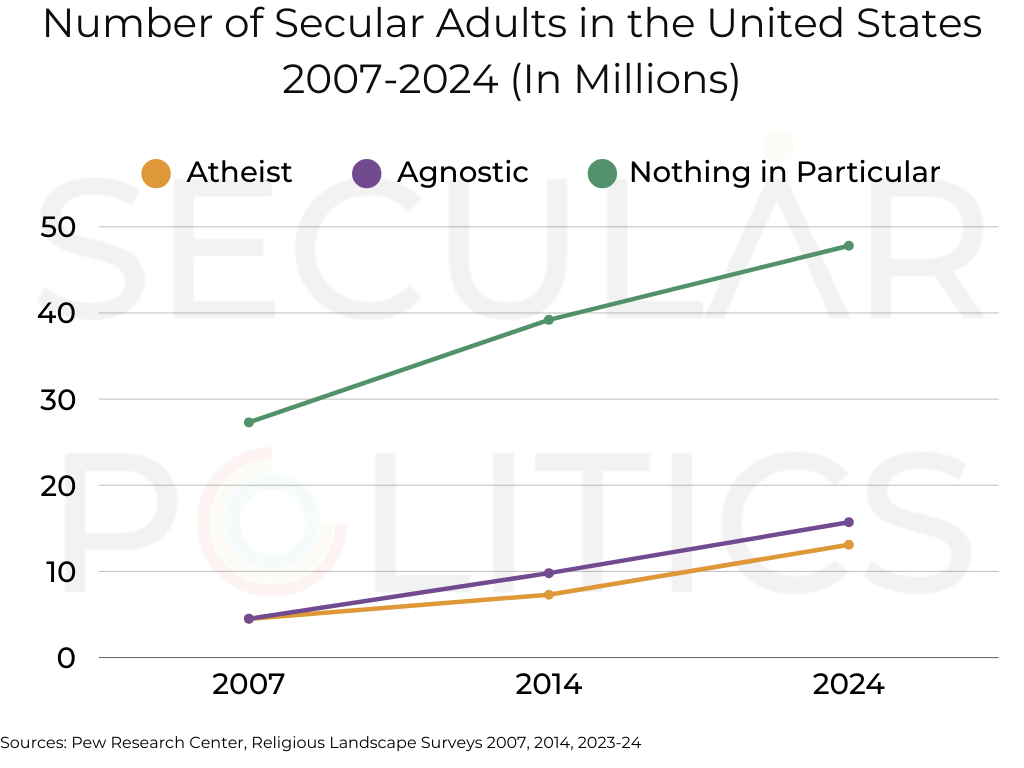
In 2007, there were just about 9 million self-identified atheists and agnostics, accounting for 4% of the adult population. Most secular adults identified as “nothing in particular” (NIP), who accounted for 12% of the population or 27 million people. The ratio of NIP to atheists/agnostics was 3:1.
By 2014, the ratio of NIP to atheist/agnostic shrank to 2.3:1. Roughly 10 million identified as agnostic, 7 million as atheist, and 39 million as nothing in particular. Seven percent of US adults identified as atheist (3%) or agnostic (4%), while 16% identified as NIP as the secular cohort approached one-quarter of the general population (23%).
In 2023-24, the NIP to atheist/agnostic ratio was further reduced to 1.7:1. About 48 million adults say they have no religion in particular, 13 million are atheists, and 16 million are agnostics.

Nonbelief on the Rise
The share of secular adults who do not believe in God has also increased. In 2007, about one in five (22%) secular adults said they did not believe in “God or a universal spirit.” This translates to about 8 million people, suggesting that most of the people who did not believe in God were generally self-identifying atheists or agnostics.
By 2014, one-third (33%) of secular adults said they did not believe in God, equivalent to 23 million adults. Since about 17 million secular adults are self-described atheists and agnostics, this means that some 6 million NIPs were also nonbelievers (roughly 15%).
The latest study finds that 45% of secular adults do not believe in God, or 34 million nonbelievers in the secular community. This is interesting because since there are about 29 million self-identified atheists and agnostics, it means that there are about 5 million NIPs who are nonbelievers.
What accounts for the change? Some may be methodological, as Pew instructs that since the last survey was purely online, there may be some comparability issues. However, I think it can also be that more people are willing to call themselves atheists or agnostics.
This seems to be the case among young people. In 2007, only 7% of adults under 30 were self-identified atheists or agnostics, and a similar share (7%) said they did not believe in God. Fast-forward to 2023-24, and 18% of young adults are atheists/agnostics by identity, while 24% are nonbelievers.
Conclusion
The USA’s secular population has been growing for more than 30 years. Nearly three in ten US adults are now nonreligious in the Pew surveys. However, contrary to the cliché that “not all nones are atheists,” the atheist/agnostic population within the secular cohort is growing at a faster pace. More people than ever self-identify as atheists or agnostics. Also, more people than ever, particularly young people, are unafraid to admit they do not believe in God. Slowly (and sometimes rapidly), the secular cohort is becoming a nonbeliever cohort