Published in Secular Politics on 7/11/2025
Last week, we learned that a majority of people in the U.S. support prayer in schools, particularly teacher-led prayers that refer to a generic God, rather than a specific religion (56%). A smaller majority (52%) also prefers prayers specific to Jesus. This trend is largely influenced by the attitudes of those who are non-religious and individuals from religious backgrounds that are not Christian. These groups overwhelmingly oppose Jesus-specific prayers. Interestingly, the levels of opposition to Jesus-specific prayers among non-religious individuals and Christians are quite similar. However, non-Christians, particularly religious ones, tend to be slightly more in favor of generic prayers than secular individuals.
When we examine Christians more closely, we find significant differences. For instance, while 71% of Christians support Jesus-specific prayers, this support is primarily driven by Protestants, about three-quarters of whom favor such prayers. Since more than six in ten U.S. adults identify as Christian, their preferences are skewing the numbers.
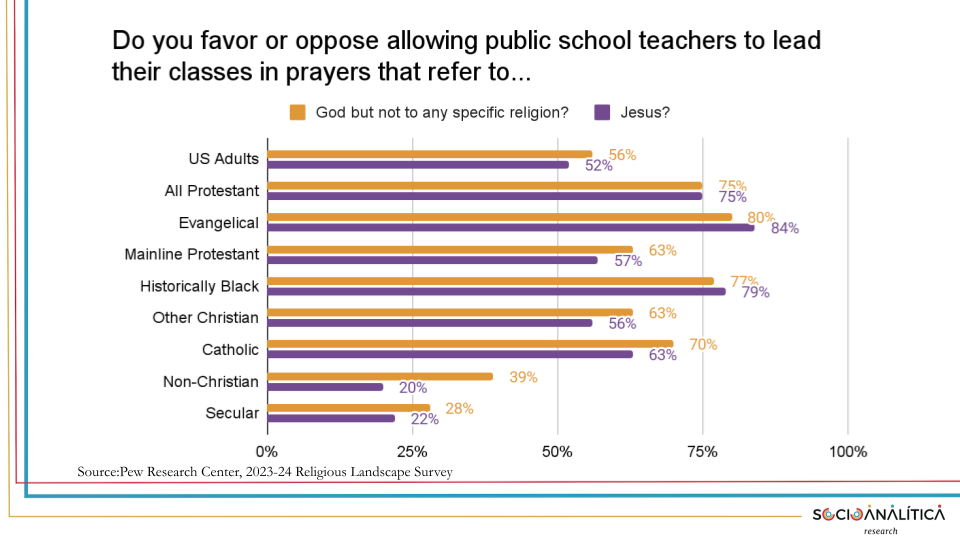
Although Christians overall prefer Jesus-specific prayers, the favorability for generic prayers often comes from those who do not belong to major Protestant denominations. For example, 63% of Catholics support Jesus-specific prayers, while 70% favor generic prayers. Like Catholics, members of other Christian traditions, such as Jehovah’s Witnesses and Latter-day Saints, are also more likely to support generic prayers over those specifically addressing Jesus, with numbers showing 63% in favor of generic prayers compared to 56% for Jesus-specific ones. Meanwhile, non-religious individuals and non-Christians overwhelmingly oppose teacher-led prayer in schools.
Significant variations exist in the support for Jesus-specific prayers, particularly among different Protestant denominations. Evangelical Protestants are the primary drivers of this support, with 84% favoring such prayers, though this figure is slightly lower in historically Black churches within the evangelical tradition. Overall, 75% of Protestants support prayers in schools that mention Jesus, compared to 63% of Catholics and 56% of other Christians. In contrast, only 57% of mainline Protestants support Jesus-led prayers.
Interestingly, while evangelical Christians show strong support for Jesus-specific prayers, they demonstrate the lowest level of support for generic prayers among Christian groups. Eighty percent of evangelicals support generic prayers, a figure that is slightly lower at 77% among historically Black churches. Mainline Protestants, in comparison, show a 57% support rate for generic prayers. Support for generic prayers is even lower among Catholics, other Christians, and secular populations. These differences largely stem from the distinct positions of evangelical Christians. Thus, the overall preference for teacher-led prayer in the U.S. is not merely a construct of Christian dominance, but rather the extreme preferences of the dominant Christian group.