As we work on our analysis of the 2026 Midterm Elections results, please read our snap analysis of 2024. Some of the points are still relevant, even with a very different outcome. [Originally published in Secular Politics on 11/9/2024]
I’m processing, both mentally and numerically, the election results. Since data is scarce, I’m scouring the exit poll data. While these surveys can be overinterpreted, they also can provide some context. Amazingly, in an election that had a bunch of theocrats promising theocratic things, religion so far has taken a backseat in the post-election takes. Despite the fact that secular voters seem to be the only ones without a noticeable rightward shift, especially compared to Catholic voters.
Secular Voters are the Democratic Party Core
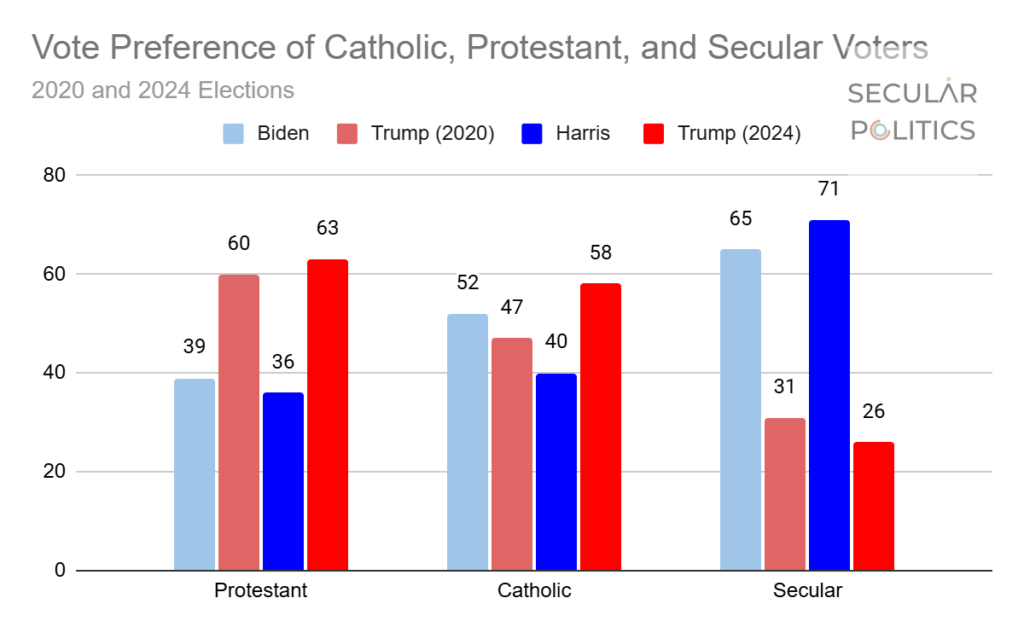
Among the three largest religion cohorts (Catholic, Protestant, and Secular), secular voters were, once again, the most likely to support the Democratic Party candidate.
Trump gained among Protestants, increasing from 60% in 2020 to 63% in 2024, an overall six-point swing in his direction. Most dramatically, Trump won the Catholic vote with a solid 58%, compared to the 52% majority Biden eeked in 2020.

Secular voters were the only ones who moved toward the Democrats; Harris gained six points compared to Biden four years ago.
Secular voters account for 24% of the voters in the exit poll and they were 22% of voters in the 2020 exit poll. With Harris now getting about 48% of the popular vote, secular voters’s share of the Democratic coalition is 36%. In other words, more than one-in-three Harris voters were nonreligious. Biden’s share in 2020 was 28% when he received 51% of the vote.

The collapse in Catholic support is also apparent in the exit poll comparison. One-quarter of Biden voters were Catholic in 2020, less than one in five (18%) of Harris voters were. It seems that what happened was an increase of support for Trump among Christians, while the secular and the non-Christian religious folk became a greater part of the Democratic coalition.
A Christian Surge
While much has been said about people of color, particularly Latinx people, shifting toward Trump, there’s not much discussion about who has shifted. Last year, I discussed how Latinx Protestants (especially evangelicals) shifted rightward after years of being essentially a swing constituency.
The rightward shift seems to continue. The exit polls show the preference of white Protestant/Christian, Catholic, and Secular voters. Unfortunately, it does not tell us more information by race and religion (probably because religion is only asked to a subsample and details cannot be as granular). However, the little information we have does suggest that Protestant/Christian and Catholic voters of color shifted rightward more than secular voters of color.

The exits show that 72% of white Protestants, 61% of white Catholics, and 27% of white Seculars voted for Trump. This means that, doing some back-of-the-envelope calculations, if 63% of all Protestants voted for Trump, about 40% of Protestants of color (Black, Latinx, Asian) voted for him as well.
If 61% of white Catholics voted for Trump, then about half of Catholics of color also voted for him, reaching 58% among the cohort. However, there is no difference between secular voters by race. Whites and people of color in that cohort strongly rejected Trump.

In 2020, voters of color, regardless of religion, supported Biden. Only white secular voters voted for him, while white Christian voters supported Trump. The shift among people of color toward Trump is more dramatic among Catholics. Considering that most non-white Catholics are Latinxs, a lot of the apparent shift in their vote may come from this specific religion cohort.
Now What?
The narrative seems to have settled about rumblings about “the economy” and “the Latinos hate immigrants.” Quite amazing that a campaign that ran as a Christian Nationalist project has received little attention in how religion played a role in the election.
Secular Warnings
I am relieved to see that the secular cohort didn’t shift noticeably rightward. It seems that fears of theocracy triumphed over the sexism and Islamophobia present in some of these spaces. Secular organizations have been warning about the threat of Christian Nationalism before the term became general knowledge.
Arguably, a reason for the rise of the secular population and its alignment with the Democratic Party has more to do with the GOP becoming a Christian Nationalist project. Will the Democratic pay attention to the growing secular cohort in their ranks?
What About Catholics of Color?
Why did Christian voters of color, particularly Catholics shift rightward? We may not get a substantive answer because journalists have never been interested in Latinx religion except to freak out when surveys come out showing that there are fewer Catholics in the community. Yet, religion is one of the best explanations for Latinx voter trends. Secular Latinxs (and other people of color) are more Democratic-leaning than Christians, and their growth benefited the Democratic Party.
Catholic Latinxs have been a dependable Democratic constituency until now. What happened? Low turnout among liberal Catholics with conservative ones emboldened by another round of Trumpism? Are younger Latinx Catholics more conservative than previous generations? It is possible, after all, liberal Catholics are becoming non-religious, so those that remains may be more conservative than previous generations when many Catholics were just nominally so.