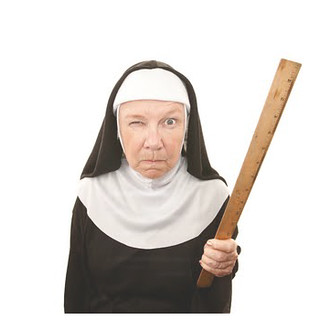
You’ll find that The Secular Vote does not refer to secular people as “nones.” And it’s not even because it sounds like “nuns” when you say it out loud (we get a kick out of that).
“Nones” was popularized by survey questions in which nonreligious participants could choose either from a list of faiths, or opt for “none of the above.”
The “none of the above” question is emblematic of the broader problem we seek to solve—the religious lens applied to research on secular people gets in the way of asking the right questions, and using the right language, which would actually lead us to better understanding the complexity of this demographic. There is still a lot more we don’t know, and would like to find out through research led by and for secular people.
As you’ll learn from The Secular Vote, the nones are diverse in many ways, including in beliefs. But you would be hard-pressed to find a secular person who describes themselves as a none.
That said, you will find people who describe themselves as “secular” and “nonreligious,” our preferred terms for this demographic that we use interchangeably throughout The Secular Vote.
And while even these words are imperfect in their own ways, they are the best and most authentic umbrella terms we have for other words like atheists, humanists, agnostics, “spiritual but not religious,” and other religiously unaffiliated people. You can find a handy glossary of secular terms on page four of the Secular Coalition for America’s Journalist Toolkit here.
It’s important to note that the word “secular” changes its meaning when describing people, as opposed to ideas (like “secular democracy” and “secular governance”) or institutions that are religiously neutral (like school and libraries). When we describe people as secular, we are referring to their theological beliefs, not their beliefs about politics or government.
It’s also important to note that not everyone who describes themselves as nonreligious are nontheists/nonbelievers—people who do not believe in god(s). Many Americans hold spiritual or religious beliefs, some of whom practice and some of whom do not. What secular believers and secular nonbelievers have in common is that their distance from the institutions of organized religion is enough to comfortably describe themselves as nonreligious. In fact, they are skeptical of institutions in general.
Of course, umbrella terms like secular and nonreligious are shorthand for a very diverse, complex and incredibly large group of people who represent over 94 million Americans. The Secular Vote is dedicated to helping you understand them. Check out our fact sheets and topline infographics to learn more.