The Secular Vote in Virginia

Virginia’s adult population is approximately 6.83 million individuals. According to the Pew Research Center, around 28% of Virginians (or nearly 2 million residents) have no religious affiliation.

Among secular adults in Virginia, half (50%) are women, while 47% are men. Nearly one in four are under the age of 30, and about 14% are over the age of 65. Furthermore, the racial composition of secular voters reveals that four-fifths are white, while one in five are people of color.
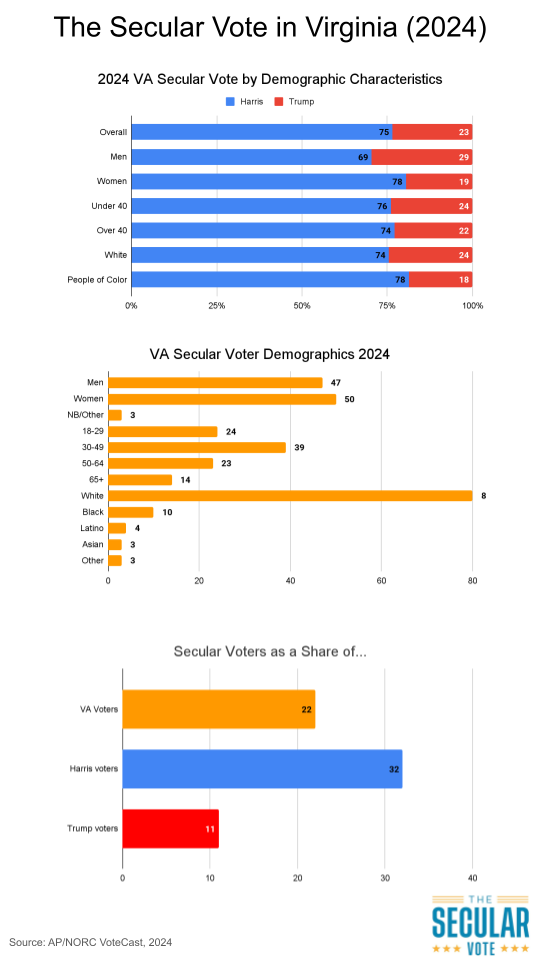
Of the  4.51 million ballots cast in the 2024 Presidential Election, about 22%, or nearly one million, came from secular voters based on the AP/NORC VoteCast. Kamala Harris, the Democratic Party candidate, won the state’s Electoral College votes with the support of three-quarters (75%) of secular voters, compared with 23% who backed Donald Trump. Nearly seven in ten men and more than seven in ten women, as well as adults under and over 40, regardless of race, secular voters supported Harris in Virginia. Secular voters accounted for three out of every ten votes cast for Harris and just over one out of ten votes for Trump in the 2024 race.

Sources: U.S. Census Bureau; Pew Research Center, 2023-24 Religious Landscape Survey; 2024 AP/NORC VoteCast

Related Blogs

Featured Articles From The Secular Vote

Dissecting PRRI’s Census of American Religion Last week, PRRI (Public Religion Research Institute) released its latest Census of American Religion,

The 2025 elections are over, with big wins for Democratic candidates in the two governorships in play, as well as

Published in Secular Politics on 10/29/2025 I want to continue with the discussion of the American Values Survey by PRRI.

Stay Informed with Our
Comprehensive Newsletter

Sign up for our newsletter to receive the latest insights, updates, and analysis on
secular voters directly in your inbox.

* indicates required

Frequently Asked
Questions

What is a secular voter?

We use the word “secular” as a catchall for voters who are unaffiliated with religion and use “secular” and “nonreligious” interchangeably. You may have seen this demographic referred to as “nones”—learn more about why we intentionally choose not to use “nones” here. We also don’t use atheist, humanist, freethinker, or other nontheist labels to describe this demographic because while the folks who use these labels account for a substantial number of the people who make up the secular cohort, secular voters are incredibly diverse in belief backgrounds and identity.

We strive to keep The Secular Vote up to date on all recent, publicly available data on the secular vote, accompanied by our expert analysis to help you understand the finer truths and nuances behind the numbers and the headlines. That said, this project is a labor of love, so we may occasionally miss some of the latest findings or studies that may not be widely distributed. If there’s something missing you’d like to flag, drop us a line at info@thesecularvote.com.

Our mission is to promote accurate and authentic representation of the secular vote. Often public narratives about secular voters are biased, inaccurate, and told through the lens of religion—even by organizations and people you might consider to be secular or secular-friendly. Learn more about how The Secular Vote came to be here.

Through the sweat, blood, and tears of our co-founders, Dr. Juhem Navarro-Rivera and Sarah M. Levin. You can learn more about them here, and chip in to support their work here.

loading...

MAP