[Note: Published as “Staying Secular” in the March 28, 2025, edition of Secular Politics]
Cradle Secularity is Rising
A significant cohort of secular folks has increased in the last decade. I call this cohort “cradle seculars.” These are people who are currently secular and were also raised as secular. The recent Pew Landscape survey gives some hints about their growth over the last two decades or so.
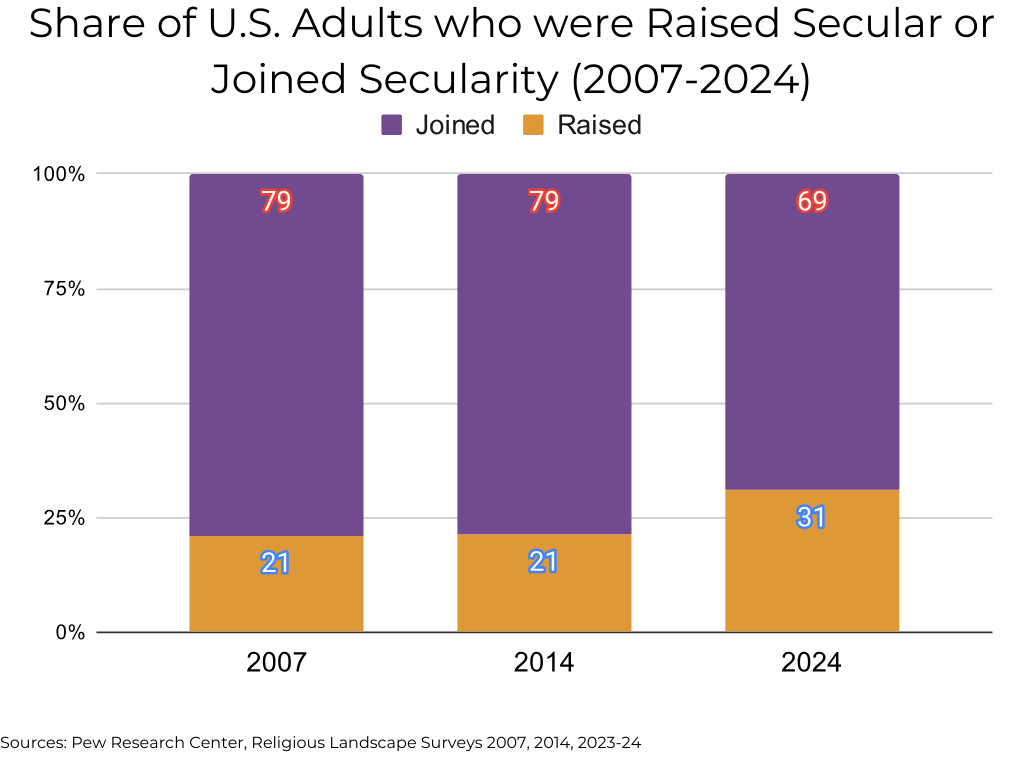
In 2007, the first Religious Landscape Survey found that 16% of the country was non-religious. It includes 7.3% of people who were raised nonreligious and 12.7% of the population who were raised as religious but became nonreligious. That adds up to 20%, but 3.9% of adults were raised nonreligious and became religious, and we have to discount those. This means that 3.4% of adults in 2007 were raised and remained secular. They were joined by 12.7% of the population who left religion to become secular. A little over one in five (21%) secular people in 2007 were cradle secularists.

In 2014, the secular population grew to 23%. This includes 4.9% of adults who were cradle seculars and 18% of adults who became secular. An additional 4.3% of cradel seculars became religious. Once again, the share of cradle seculars in the adult population was 21%, or about one in five.
The most recent survey shows that 9.1% of US adults are cradle seculars, while an additional 20.2% have joined the ranks of the nonreligious. Only 3.5% of adults became religious after being raised secular. The share of secular adults increased by 10 percentage points, and today, close to one in three (31%) secular adults were raised without a religion.
Better Retention of Cradle Secularity
In 2007, a majority of people who were raised as secular went elsewhere as just 47% of cradle seculars said they were still nonreligious as adults. That may have given some credence to the assumption that people become more religious as they age. However, that has been debunked over time, particularly in the 2023-24 survey. The 2014 survey found that 53% of people raised secular remained secular in adulthood. The latest poll shows that 73% of cradle seculars remained so.
Slowdown in Deconversion
The idea that secularity is just a fad and that people will just go back to God after they have children or other life events happen is not panning out. This is also reflected in the fact that in the period between the 2007 and 2014 surveys, the vast majority of secular growth came from secular joiners (78%), while just 22% of growth came from cradle seculars. However, in the lastest intersurvey period (2014-24), most of the growth came from cradle seculars (59%). This suggests that while people raised secular are more likely to become secular, we may start seeing a slowing down in the cohort’s growth. While people will likely continue leaving organized religion, I guess that we have tapped the core of people who were tangentially religious (bound by culture, tradition, or inertia). The currently religious are probably more orthodox than those who have left in the last three decades.
We Are Not Alone
I do not mean aliens, though. Pew released an international version of the Landscape survey, and two things jumped out at me. First, secularity is rising in all the countries polled. Second, the retention rate of cradle seculars in all these countries is very high. A majority of people raised secular have remained so.