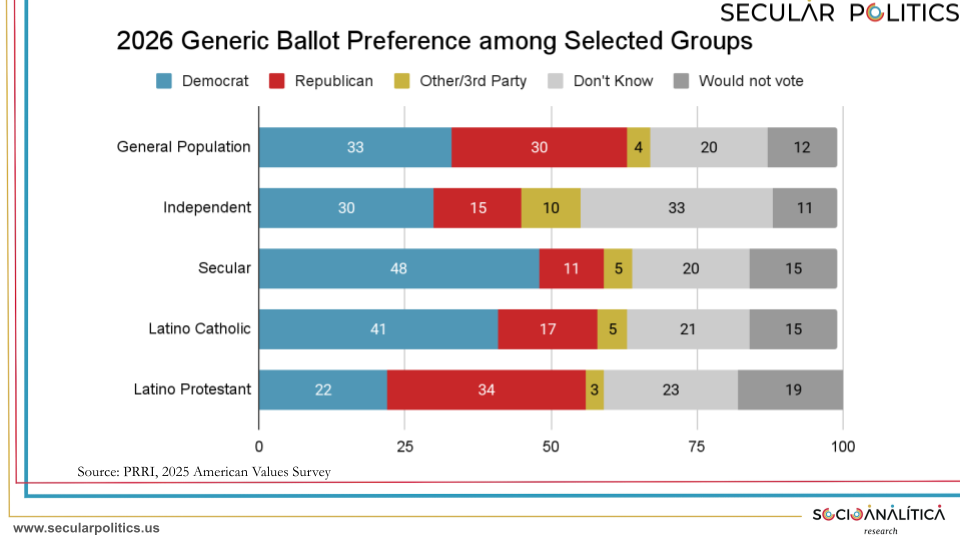
Secular voters in the United States have consistently leaned toward the Democratic Party in recent decades. Since 1980, nonreligious voters have favored Democratic presidential candidates, and the 2020 election continued this trend. According to the 2020 National Exit Poll, 65% of secular voters supported Joe Biden, while 31% backed Donald Trump. This mirrors the results of previous elections.
The AP/NORC Votecast, a large study involving over 100,000 voters, found similar trends. Among more than 30,000 secular respondents, the data revealed that nearly three-quarters (72%) of secular voters supported Biden. This group was the most Democratic-leaning, with Jewish voters following at 69%, and Muslim voters at 64%.
In contrast, Christian groups showed stronger support for Trump. Born-again Christians (68%), Mormons (71%), and other Christians (57%) largely voted for the Republican candidate. Catholics were almost evenly divided, with 50% supporting Trump and 49% backing Biden. This highlights the sharp religious divide in U.S. voting patterns, with non-Christians mostly supporting Democrats and Christians leaning toward Republicans.
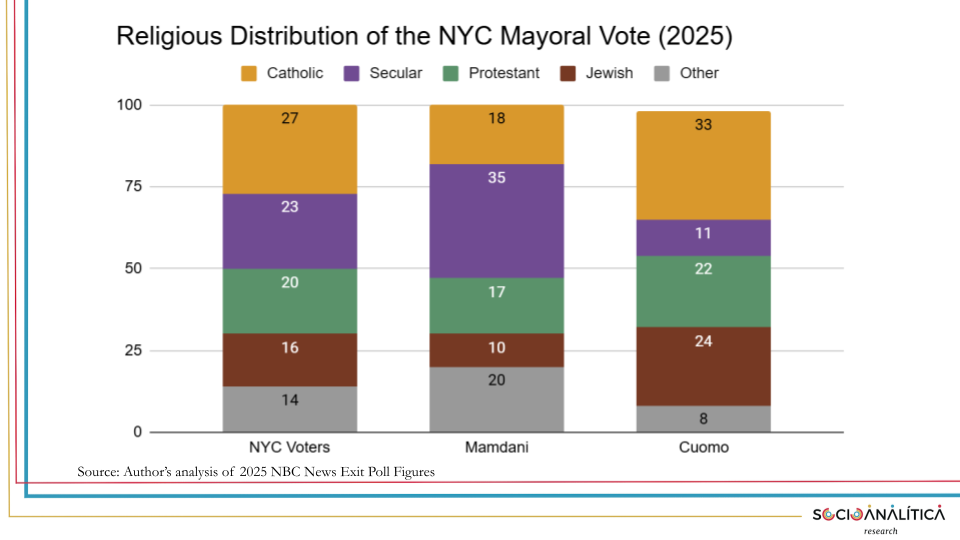
Although Christian voters made up 66% of the electorate in 2020, they comprised 80% of Trump’s base. Among these Christian Trump voters, Protestants and born-again Christians made up the largest share at 54%, while Catholics accounted for 24%. Secular voters, on the other hand, represented a growing segment of the Democratic base, making up 30% of Biden’s coalition, compared to only 12% of Trump’s. Notably, secular voters are younger than their religious counterparts, with 62% under 50 years old, suggesting that this group is likely to become even more influential in future elections.
The rise of secular voters has coincided with the increasing visibility of white Christian nationalism in the Republican Party. This movement, driven in part by fears of losing racial and religious dominance, has alienated secular voters. While the Democratic Party may not have always been welcoming to secularism, it is far less hostile to it than the current version of the GOP. As a result, secular voters are becoming a critical part of the Democratic base.
Several recent events are likely to reinforce this trend. The GOP’s attack on reproductive rights, epitomized by the Supreme Court’s Dobbs decision, has mobilized secular voters, who tend to be strongly pro-choice. Additionally, the Court’s ruling in the Kennedy case, which weakened the separation between church and state, and the GOP’s attacks on LGBTQ+ rights, particularly transgender individuals, have further alienated secular voters. Many secular individuals are ardent supporters of LGBTQ+ rights, and the secular cohort includes a disproportionately large number of LGBTQ+ people.
Looking ahead, the growing number of secular voters, combined with their younger demographic profile, suggests that this group will play an increasingly important role in the Democratic Party’s future success.